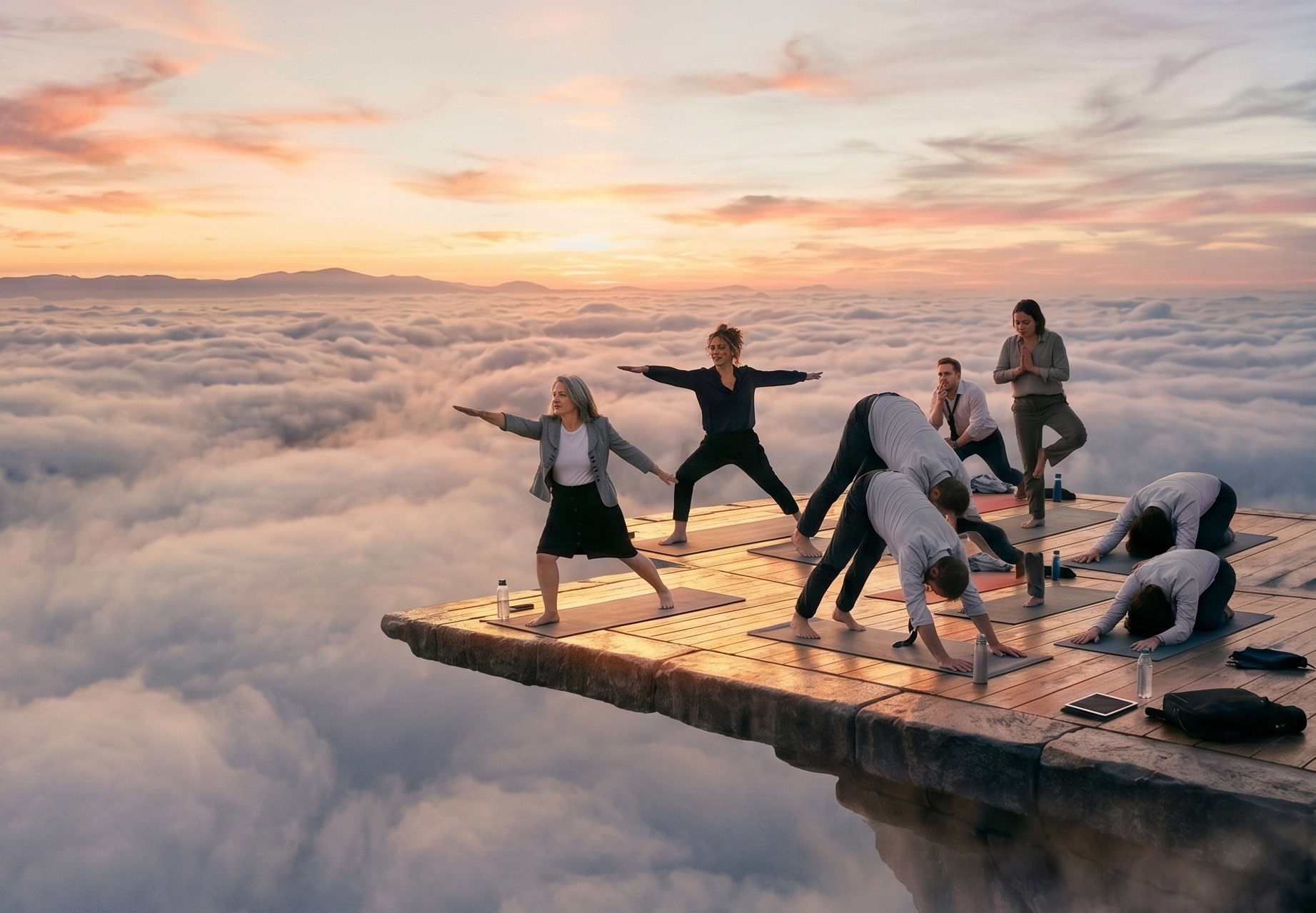
“Modern wellness culture turned yoga into an opportunity to sell bamboo water bottles to emotionally exhausted corporate professionals while pretending that buying £120 leggings counts as spiritual development”
Me, exercise?
Yoga is one of the few movement techniques that I actually enjoy. Apart from the only other format of movement, which is walking and hiking, I don’t really enjoy any form of exercise. Gyms often feel performative and aggressive to me. Loud music, mirrors everywhere, fluorescent lighting, protein shaker culture, endless “push harder” mentality, people filming themselves doing lunges for Instagram as though humanity desperately needed another inspirational glute transformation video. None of it ever felt calming or healthy to me. Even yoga was difficult to pick up in the early years.
My relationship with yoga over the years has been tainted by the fake western yoga teachers, who live very much western lifestyles with their cliche western thinking, secretly eating bacon, wearing leather jackets and their ultra expensive lycras, driving around town in their big-ass bright red Audis, freely throwing away plastic in landfills without any care, shooting through the roof with their carbon footprints by jet-setting across the world on airplanes and helicopters, and then claim to be spiritual, caring, loving yogis while they don’t give a tiny rat’s ass about a single living thing or their environment. Yes they really do exist and not far from you. They have fake instagram accounts posing to be down to earth loving yogis.
Somewhere along the line, ancient Eastern systems built around discipline, consciousness, simplicity, breath, meditation, nervous system regulation, spiritual philosophy, and respect for nature became transformed into an absurd commercial circus of £120 leggings, narcissistic Instagram poses, luxury yoga retreats in Nepal requiring three long haul flights and twelve filtered selfies, “spiritual influencers” taking helicopter rides over Himalayas while talking about grounding energy, and yoga teachers preaching compassion while screaming at minimum wage staff because their oat milk latte arrived lukewarm. I’m not even making these up, I have unfortunately known a few of these people. They preach mindfulness while scrolling social media obsessively. They talk about energy alignment while wearing fast fashion made in exploitative factories.
But I have also met genuine yoga teachers who truly believe and follow the real ancient yoga wisdom. I’m not expecting all yoga teachers to live like monks but a little respect to ancient practices go a long way. Beneath all of that commercialised Western performance culture, I still believe there is something incredibly valuable and profound inside genuine yoga practice itself. I have also met yoga teachers who truly respected the roots of the practice and lived with humility, discipline, kindness, and integrity rather than treating yoga as lifestyle branding.
The Beginning
I knew nothing about yoga when I joined my first ever class. I received a free voucher to join a class in Balham, in South London and that was it. I had zero expectations. It was a Bikram yoga, the really hot kind… I have to say, I absolutely despise everything about it. Sweaty people gross me out on a good day. 90 minutes inside a 50 degrees room with neighbouring people dripping on my towel is a step too far for me. So that’s a no.
But Vinyasa Yoga flow is deeply relaxing and energising for me. I have done many classes of this. I even did 1:1 yoga lessons when I was supporting a yoga teacher friend as she was starting out in her business. I’m a big supporter of women entrepreneurs and I do believe that when I help people, it will eventually come back to me, karma and all that. So I’m always very generous with this type of help and support, even to the point of being taken advantage of regularly, by people who only take but never give. But that’s an article for another day…
Anyways I have done many Vinyasa flow classes and it has become my favourite type of yoga. Unlike rigid exercise routines, Vinyasa feels fluid, rhythmic, meditative and physically intelligent at the same time. Most daily movement now consists of sitting, driving, looking at screens, rushing between obligations, collapsing onto sofas, then repeating the cycle again the next day. The body stiffens quietly over time. Hips tighten. Hamstrings shorten. Posture collapses. Breathing becomes shallow. The nervous system remains continuously activated. Yoga interrupts that pattern in a way very few other movement systems does for me.
Vinyasa Yoga
The form of yoga that resonates most strongly with me is Vinyasa flow. Vinyasa is often described as a flowing style of yoga where movement synchronises with breath in continuous sequences. Unlike more static forms of yoga where poses are held for long periods, Vinyasa creates rhythm and fluidity between positions. Done properly, Vinyasa feels like a moving meditation.
Breathing becomes central to the practice. The transitions themselves matter as much as the poses. Attention gradually shifts away from overthinking and back into the body. I think this is one of the reasons Vinyasa feels so regulating for modern nervous systems. Most people rarely experience uninterrupted rhythmic movement combined with controlled breathing anymore.
But there’s something very disruptive about planning to attend a class, book a place, packing your bag, leaving your desk, driving, finding a parking spot, chit chatting with class mates, doing the class (which is always great), then driving back, showering, getting changed, then trying to concentrate back at work and now the day is even shorter and nothing gets done. This beats the purpose of relaxation and stress busting for me. I decided that I can’t do it and I stopped forcing myself trying to drag myself to these classes.
Build Your Own Sequence
I found an extremely useful website although it requires some experience of yoga in order to use it effectively. It’s a website called Tummee.com which is a Yoga Teachers Platform. There are thousands of yoga poses to choose from from all modalities of yoga all over the world. You can drag and drop your poses, you can build your sequence by type of yoga, your level, the outcome you’re looking for filter by outcome (relaxation, back, hips and so on), and then drag and drop the poses into your plan and save.
The site has payment plans but I’m not a yoga instructor so I used it completely free. I selected 30 poses that I know very well, I took a screenshot of each and pasted them into a powerpoint slide. I printed it out and stuck it on my wall next to my bed. and there was my morning flow!
Sun Salutations
One of the core sequences within many yoga traditions is Surya Namaskar, commonly translated as Sun Salutations. Sun salutations involve a flowing sequence of movements linked to breathing patterns traditionally practised in the morning. The sequence usually includes combinations of forward folds, lunges, planks, cobra or upward dog, downward dog and standing poses. The sequence generates heat gradually while stretching and activating the entire body.
Within Ayurvedic traditions and broader yogic philosophy, morning practices hold enormous importance because the body is viewed as highly responsive to early morning rhythms. Waking close to sunrise, exposing the body to natural light, drinking warm water, oil massage, breathing practices, meditation and movement are all traditionally viewed as ways of aligning the body with natural circadian cycles.
The importance of morning light and regular rhythms closely associates with digestion timing, nervous system regulation, movement shortly after waking, reducing stress accumulation, and creating intentional transitions into the day.
My Home Practice
I’m a huge fan of the morning sun salutation routine. It’s a key concept in Ayurvedic practices which I have come across this in various workshops in slightly different forms. It involves waking up with sun rise, around 6am, taking a hot shower, drinking some hot water, self massage with oils, meditation, breathing and finally the sun salutations which is the yoga flow. If I have the morning all to myself, I do the whole lot. If I’m short of time, then I only do the shower which I have to do anyway before work, and I add the yoga flow. The sequence I built takes 20 mins and fully stretches me, warms me up, gets rid of all aches and pains and makes me feel great. This has been my routine for over 2 years now. I don’t go to any yoga class, I don’t follow youtube yoga videos, I don’t join anyone else. I quietly meditate and do my flows and stretches and I feel great. If it’s a warm sunny day, I do it in my garden which feels even more amazing. That’s my way of saying that natural sunlight, fresh air, birdsong, movement and stillness all combine into something profoundly grounding.
The biggest difference between my own home practice and studio yoga is psychological. Once yoga stopped becoming an event and instead became part of ordinary life, it felt much more authentic and sustainable. My morning sequence takes around 20 minutes and includes flowing stretches, mobility work, breathing, and sun salutations. The effect is immediate and consistent. The body warms up. Tightness disappears. Energy improves. Breathing deepens. Mental tension softens.
What I also appreciate about practising alone is that it removes performance entirely. Modern yoga culture often feels strangely narcissistic despite claiming spiritual depth. I don’t use this word lightly but I spent 20 years being a close friend of a narcissistic which left me with deep scarves. Endless posing, branding, aesthetic perfection, flexibility competition, retreat photography, influencer culture and wellness consumerism distort something that was never originally intended to function as social media content. Practising alone stripped yoga back to what actually mattered for me; movement, breathing, calmness, preparing for the day.
On a physical level, yoga also helps reduce all the aches and pains, joint stiffness, neck and shoulder pains, and makes me a nicer person at work! I don’t even have to go to the gym for it and it doesn’t cost me a penny. Life is so liberating when you’re not trying to sell something!
The Science
Yoga helps shift the body toward parasympathetic regulation through controlled breathing, movement, stretching, and mindful attention. Breathing itself is an underestimated aspect of yoga. Slow controlled breathing influences vagal tone, heart rate variability, stress physiology and emotional regulation. There is also growing research around yoga therapy in supportive cancer care, particularly involving fatigue reduction, sleep support, anxiety reduction, emotional wellbeing, recovery support and many other benefits.
In the old days, doctors used to tell cancer patients not to move or exercise because there was fear that this would make the cancer spread. Those days are gone thankfully. Nowadays the advice is the opposite, there is increasing research and evidence that patients who exercise regularly, oxygenate more and recover faster. The oxygenation side is fascinating. Tumour environments are often hypoxic, meaning they’re relatively low in oxygen compared to healthy tissue. While simplistic claims that “oxygen kills cancer” are too reductionist, there is genuine scientific interest around how circulation, vascular function, metabolic flexibility and oxygen utilisation influence health and recovery broadly. Exercise improves circulation, cardiovascular efficiency, tissue perfusion and mitochondrial activity in ways that appear deeply supportive to overall physiology.
Modern oncology and integrative cancer care increasingly recognise that appropriately tailored movement and exercise may actually be one of the most supportive things many patients can do during and after treatment. Exercise is now being studied not only for physical fitness but for its effects on inflammation, immune regulation, insulin sensitivity, fatigue reduction, mitochondrial health, mental wellbeing, circulation, recovery capacity, and even long term survival outcomes.
There is now growing evidence showing that regular physical activity is associated with improved outcomes across several cancer types, particularly breast, colorectal, and prostate cancers. Patients who remain physically active during treatment often report lower fatigue, better mood, improved sleep, improved mobility, better treatment tolerance, faster recovery, greater independence, improved quality of life.
Cancer related fatigue itself is one of the most debilitating symptoms patients experience and interestingly exercise now appears to be one of the most effective supportive interventions for managing it. That sounds almost counterintuitive initially because exhausted people naturally assume rest is the answer. But prolonged inactivity can create its own downward spiral of muscle loss, reduced cardiovascular fitness, poorer circulation, stiffness, de-conditioning, insulin resistance, and worsening fatigue. Movement interrupts that cycle.
Modern research is now rediscovering things many traditional healing systems intuitively understood long ago. Human beings were never designed to remain completely sedentary during illness unless absolutely necessary. Gentle movement, circulation, breathing, sunlight exposure, stretching, walking, and maintaining connection to the body all appear important for resilience and recovery.
So…
Unfortunately modern wellness culture turned yoga into an opportunity to sell bamboo water bottles to emotionally exhausted corporate professionals while pretending that buying £120 leggings counts as spiritual development. The irony is that the more commercialised yoga becomes in the West, the further it often drifts from the simplicity that made it powerful in the first place. Yoga is supposed to help human beings become calmer, healthier, more disciplined, more conscious and more connected to themselves and the world around them. and it doesn’t need to cost a penny…
Previous Articles
- A Brilliant Life Is an Accumulation of Many Brilliant Days – Here’s My Perfect Health Day
- A Simpler Way to Eat Healthy Meals Without the Cognitive Overload
- My Poor Feet, Barefoot Shoes and Plantar Fasciitis
- Yoga, Vinyasa Flow, Morning Sun Salutations – I Do It Quietly and All by Myself at Home
- I Tried the ADS Vitality Chronotype Test and Discovered I’m a Strong Evening Owl